Most Companies Compare Prices. Leading GCCs Compare These 10 Criteria.

A Decision Framework for Choosing your Corporate Food Services Partner
Food at work has quietly become one of the most influential workplace investments.
It influences where employees choose to work, how often they come into the office and how they experience the workplace every day.
Research increasingly shows that workplace dining is about far more than convenience. HubSpot found that 88% of companies reported a 50% or greater increase in office attendance when food was available, while 78% of employees said workplace meals made them feel more valued.
Yet when Global Capability Centres (GCCs) evaluate corporate food services, the conversation often starts with a single question:
“Can you match our current price?”
Price matters. But it is only one part of a much bigger decision.
Choosing a workplace dining partner influences employee experience, business continuity, workplace wellbeing, governance, sustainability and ultimately the value employees associate with coming to work.
The most successful GCCs don’t evaluate food service providers solely as vendors.
They evaluate them as strategic partners that help create a better workplace.
Whether you’re in HR, Facilities, Administration, Procurement or Business Leadership, aligning on a common decision framework helps ensure long-term value rather than short-term savings.
The Workplace Dining Decision Framework
Every GCC will prioritise these areas differently based on its workforce, operating model and business priorities. However, these ten evaluation areas consistently form the foundation of a robust partner selection process.
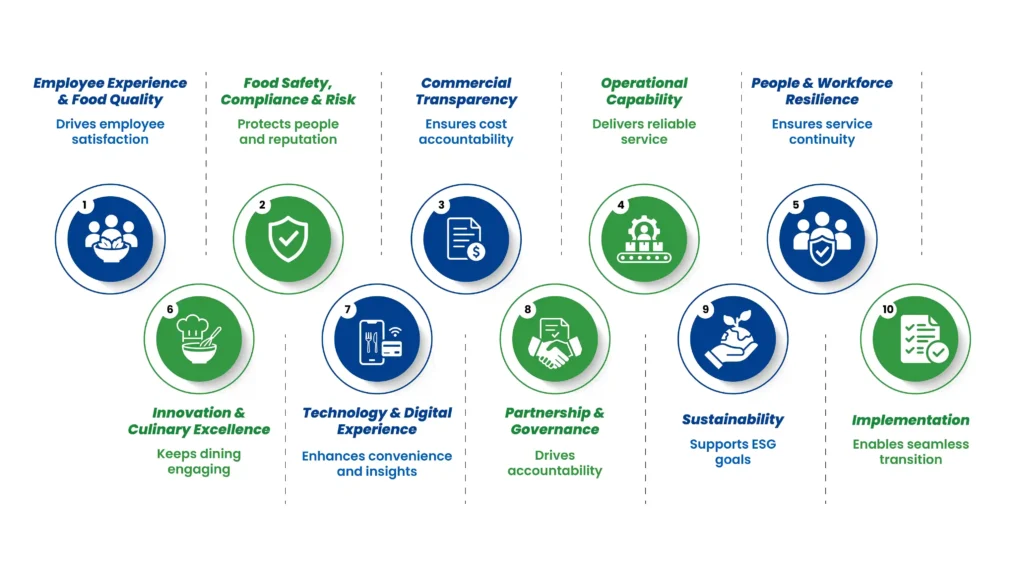
The 10 Questions Every GCC Buying Committee Should Ask
1. How will your food programme measurably improve employee experience, wellbeing and workplace culture?
Look for: Employee satisfaction scores, nutrition-led menu planning, menu refresh cadence, personalization for dietary and cultural preferences, structured employee feedback programme
2. How do you prevent food safety risks before they occur?
Look for: Food safety certifications, third-party hygiene audits, ingredient traceability, allergen management protocols, crisis response procedures
3. Can you deliver commercial transparency without compromising quality?
Look for: Transparent pricing models, inflation management approach, open-book reporting, total cost of ownership, commercial governance practices
4. Can you consistently support our GCC as it grows?
Look for: Experience managing sites of similar scale, structured mobilization plans, supply chain resilience, business continuity processes, operational scalability
5. How will you maintain service levels during staffing shortages or unexpected disruptions?
Look for: Workforce contingency plans, cross-trained teams, bench staffing model, recruitment capability, critical role continuity plans
6. How will you keep the workplace dining experience fresh and relevant over time?
Look for: Dedicated culinary and nutrition teams, seasonal menu innovation, chef-led concepts, consumer trend tracking, employee tasting and feedback sessions
7. How does technology improve the workplace dining experience?
Look for: Mobile ordering and payment, workplace dining app, live dashboards and reporting, consumer insights, integration with workplace systems
8. Will you act as a strategic partner rather than simply a service provider?
Look for: Executive sponsorship, dedicated account management, Quarterly Business Reviews (QBRs), clearly defined KPIs and SLAs, continuous improvement roadmap
9. Can you demonstrate measurable sustainability outcomes?
Look for: Food waste measurement, responsible sourcing practices, sustainable packaging initiatives, ESG reporting, employee sustainability programmes
10. How will you ensure a seamless transition with minimal disruption?
Look for: Detailed implementation plan, transition milestones, risk mitigation strategy, change management approach, stakeholder communication plan
Selecting a corporate food services partner is no longer just an operational or procurement decision. It is a workplace decision.
The right partner should do more than serve meals. They should strengthen employee experience, support workplace wellbeing, protect business continuity and deliver measurable value through innovation, governance and operational excellence.
Every GCC will prioritise these evaluation areas differently, but one principle remains the same:
The best workplace dining programmes aren’t chosen because they’re the cheapest. They’re chosen because they consistently deliver better business outcomes.