The Fundamentals of Food Hygiene in Modern Food Services
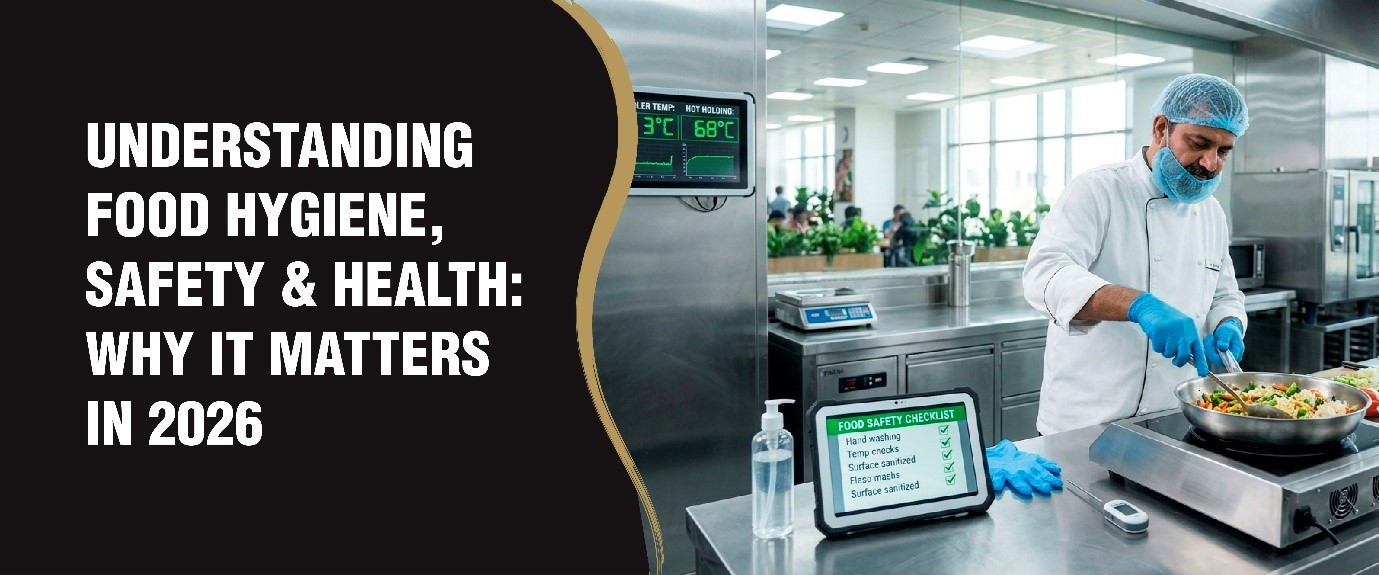
For years, food hygiene was about passing inspections and meeting compliance requirements. That is no longer the case. In 2026, the focus has shifted to protecting people, improving productivity, and earning trust. From hospitals and factories to offices and corporate cafeterias, safe food is not just a background task, it is a business priority.
Table of contents
- Understanding Food Hygiene, Safety & Health: Why It Matters in 2026
- Why Food Hygiene Extends Beyond the Kitchen
- India’s Food Safety Landscape – Key Signals (2023–2026)
- Food Hygiene vs Food Safety vs Food Health – A Practical Framework
- Operational Hygiene Practices – Food Hygiene
- System-Level Food Safety Controls – Food Safety
- Health Outcomes and Workforce Well-being – Food Health
- Why Food Hygiene Matters More in Workplaces Today (2026)
- Workforce Productivity and Absenteeism
- ESG and Corporate Governance Expectations
- Supply-Chain and Vendor Risks
- Heightened Expectations and Scrutiny
- The True Value of Robust Food Hygiene Systems – Beyond Compliance
- Operational Benefits
- People and Productivity Benefits
- Brand and Reputation Benefits
- Technology-Driven Food Safety – The 2026 Shift
- Compass Perspective: Embedding Preventive Food Safety Systems
- Reimagining Food Hygiene in 2026
- Key Takeaways
Why Food Hygiene Extends Beyond the Kitchen
In the modern workplace ecosystem, unsafe food does not just stay in the cafeteria. The impact can spread far wider:
- Health risks for employees and visitors.
- Loss of productivity from illness and fatigue.
- Reputation damage – Even a single outbreak can damage your brand.
- Compliance issues, especially with new ESG standards and regulations.
Globally, unsafe food remains a major public health issue, causing an estimated 600 million infections and ~4.2 lakh deaths every year.
India’s rapidly growing dining and contract food service sector makes this even more critical. Organisations today are increasingly asking, “Is the food behind our operations truly safe?”
India’s Food Safety Landscape Key Signals (2023–2026)
Here are the recent developments that show both progress and persistent gaps:
- More than 80% of Indian consumers now consider food safety before choosing a brand or service (PwC Voice of the Consumer 2025).
- Enforcement teams continue to find problems: In 2024–25, Rajasthan identified 863 food samples as unsafe, with thousands more deemed substandard. Consistency remains a challenge.
- In Gujarat, officials seized 351 tonnes of questionable food in 2024–25, highlighting supply-chain vulnerabilities.
- A single incident can escalate a 2025 food poisoning case in Delhi affected hundreds of people.
All this signals a crucial shift: Food safety cannot rely on random spot-checks anymore. Prevention must be built into every layer of the system.
Food Hygiene vs Food Safety vs Food Health – A Practical Framework
Instead of viewing hygiene as just cleaning alone, we can focus on three interconnected layers:
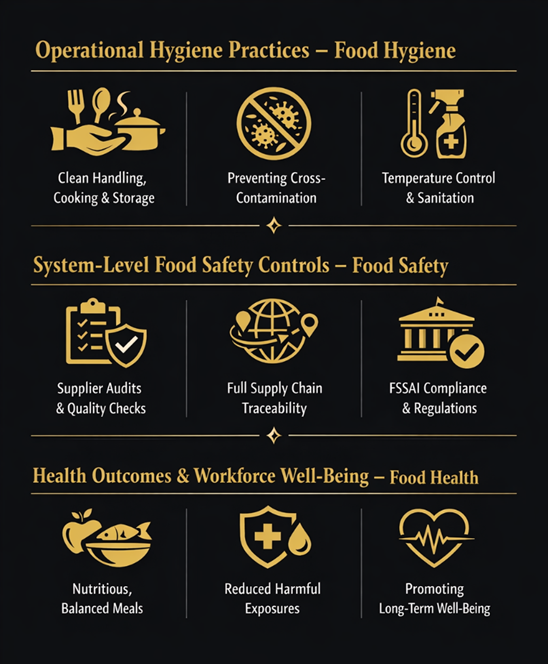
When these three layers function together, we can shift the workplaces from reactive responses to proactive, preventive health systems.
Why Food Hygiene Matters More in Workplaces Today (2026)
Every day, Indian workplaces serve thousands across office campuses and factories, to hospitals and remote sites. This brings significant responsibility, but also real opportunity.
Here’s why food hygiene is essential now:
Workforce productivity and absenteeism
- Safe, nutritious meals reduce sick days.
- Better nutrition improves focus and energy.
ESG and corporate governance expectations
- Food safety now affects employee well-being measures.
- Investors and global partners closely monitor health standards.
Supply-chain and vendor risks
- More vendors, cloud kitchens, and outsourcing increase risks.
- Traceability and monitoring are needed to manage it all.
Heightened expectations and scrutiny
- More inspections and testing.
- Employees and consumers expect higher standards.
Food safety is not just about following regulations anymore. It is about protecting your people, your brand, and your future.
The True Value of Robust Food Hygiene Systems – Beyond Compliance
When organisations see food safety as more than a checklist, the benefits are measurable, and they show up everywhere:
Operational
- There is less food wastage thanks to proper storage and monitoring.
- Safety incidents decrease; complaints stay manageable.
- Audit performance becomes better.
People and Productivity
- Your employees have lower health-related absenteeism.
- Better employee satisfaction leads to an improved workplace atmosphere.
- Improved environment draws in talent and encourages people to stay.
Brand and Reputation
- Employees, visitors, and partners start to trust you more.
- Your standing as an employer improves.
- You become known for genuinely caring about people’s well-being.
Technology-driven Food Safety – The 2026 Shift
The food service industry is evolving quickly. We are moving beyond old-fashioned, manual inspections. Now, data-driven hygiene systems and technology help us get ahead of problems instead of just responding to them.
Emerging practices include:
- IoT sensors continuously monitor temperatures in kitchens and storage areas.
- Digital hygiene audits and real-time compliance dashboards mean you always know your status.
- Predictive analytics identify risk patterns before they become problems.
- Automated traceability tracks every link in your supply chain.
- Smart tools monitor inventory and expiry dates.
With these solutions, food safety teams do not wait for issues to occur. They get ahead of problems and resolve them.
Reimagining Food Hygiene in 2026
Instead of just asking, “Is the kitchen clean?”, leading organisations are asking deeper questions:
- Is our food safety system predictive or reactive?
- Can we see what is happening in real-time, from the supplier to the kitchen?
- Are we leveraging data and automation to identify risks early?
- And is our workplace dining programme truly supporting employees’ health?
This transformation, from simple inspections to using intelligence and insights, marks the future of workplace food safety.
Key Takeaways
- Food hygiene is not just a regulatory requirement; it is a real focus for workplace health and keeping teams productive.
- Even with stricter standards, new data from India shows that contamination risks still arise.
- Technology is making a difference. Automation, analytics, and advanced tools are raising the bar for food safety.
- Organisations that make hygiene a core part of their systems do not just avoid issues; they operate more efficiently, build trust, and support healthier employees.
- The future of food safety emphasises continuous monitoring, traceability, and using data-led decision-making.