Your GCC Runs 24/7. But Does Your Workplace?
The smarter way to design workplace services for the hours when most of the building is asleep
A truly 24/7 workplace does not need everything running at full capacity 24/7. It needs the right things running at the right time, based on who is working, what they need and where human intervention actually adds value. That distinction matters as India’s GCC ecosystem expands beyond traditional night-shift functions. Technology, finance, analytics, engineering and global business teams are increasingly working across time zones and geographies.
For Admin, HR and Workplace Experience leaders, the question is no longer simply whether the office can operate through the night. It is “Can the workplace deliver the same standard of experience at 2 AM that employees expect at 2 PM?”
The operating model may change. The standard shouldn’t.
Start With the Employee, Not the Operating Model.
Consider what changes between 2 PM and 2 AM.

At 2 PM, there is high occupancy, full support teams, regular cafeteria operations and people everywhere to spot and resolve issues.
At 2 AM, there are fewer employees, leaner teams, different consumption patterns and less physical oversight.
The answer isn’t to simply replicate the daytime workplace after dark. It is to understand what employees actually need at different hours and design services around that demand. And food offers a useful window into this.
Food Services: Don’t Run the Cafeteria. Run the Demand.
There is no single model for night shift food services. So does every GCC need a full cafeteria with a full daytime menu running through the night? Not necessarily.
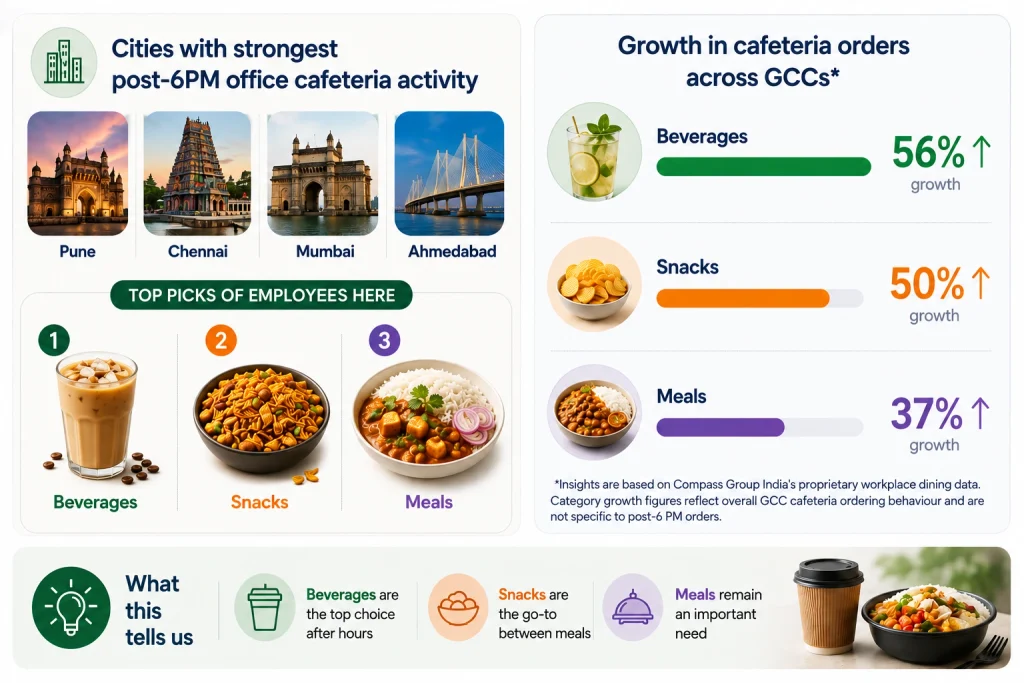
A lower-footfall night operation could instead combine all-day breakfast, one dependable main meal window, curated snacks and hot and cold beverages with pantry, vending and grab-and-go formats. That is not reducing the employee experience. It is reducing unnecessary operating complexity while protecting what employees actually value.
Digital ordering can make this even more precise. Transaction-level and time-based dining data can help answer questions such as: What does this workforce actually want at 11 PM, 1 AM or 3 AM? The answer could determine operating hours, menu depth, staffing and replenishment rather than assumptions. And standards like food quality, freshness, food safety, allergen controls, nutrition and access to a hot meal should remain non-negotiable. The breadth of choice can change. For instance, if a daytime food festival offers eight items, the night shift may get a curated selection of 3-4 options based on what employees actually prefer.
There is another interesting signal. In Pune, Chennai and Bengaluru, employers subsidise approximately 59%, 46% and 43% respectively of employees’ food and beverage costs on campus* where Pune and Chennai also rank among the strongest post-6 PM food markets, linking higher night-shift activity with greater employer investment in food as a workplace benefit. When employers are already investing in food as a workplace benefit, shouldn’t that benefit work for employees across shifts too?
Facility Management: Ask What Really Needs a Person.
The people equation gets harder after dark. Frontline staffing is already a daily challenge. With even fewer people available at night and lower on-ground oversight, relying on manpower alone becomes even harder to sustain. Instead of asking “How many more people do we need?”, ask: What actually needs a person and what all can technology take care of?
Consider a smart washroom. Ammonia sensing can identify odour. Footfall sensing can indicate usage. And a BLE pager can help coordinate intervention. With AI-enabled workflows, a flagged requirement can trigger a task, route it to the right team and verify completion. At 2 AM, that matters. The objective isn’t to have more people looking for problems. It is to have technology find the problems worth sending people to.
The same principle can extend beyond washrooms. Connected facility platforms can bring IoT data, asset monitoring, digital workflows and automation into one operating model. Autonomous cleaning can take on defined routine tasks while frontline teams focus on supervision, exceptions and work that requires human judgement. This is where integrated facility management becomes more than simply managing multiple services. It becomes a way to make the workplace more visible, responsive and resilient when physical oversight is limited.
That is what 24/7 workplace facility management services should increasingly deliver:
People for judgement. Technology for visibility. Automation for repetition.
For GCCs evaluating facility management providers, the value is not technology for technology’s sake. It is greater resilience, faster response, better visibility and less dependence on manual intervention when support teams are leaner.
The Real Test for a 24/7 Workplace
Walk through your workplace at 2 PM. Then imagine walking through it at 2 AM.
- Would employees still have access to the food they actually want?
- Would a facility issue be detected before someone has to report it?
- Would the right team know what needs attention?
- Could routine work continue without requiring someone to physically monitor everything?
- Would the workplace still feel considered, safe and supported?
For GCCs, the future of workplace services for night shifts isn’t about keeping every service running exactly as it does during the day. It is about understanding demand, designing the right service model and connecting food, people, technology and facilities around it.
Because the smartest 24/7 workplace isn’t the one that does everything around the clock. It is the one that knows what needs to happen at every hour.
*Source: Compass Group India’s proprietary workplace dining data across GCC cafeterias. Category growth figures reflect overall GCC cafeteria ordering behaviour and are not specific to post-6 PM orders. Subsidy figures represent the employer-funded share of food and beverage costs on campus.