Green Buildings and Beyond: How Facility Management Powers Sustainable Infrastructure in India

Table of Contents
- India’s Green Building Revolution
- Why Sustainable Buildings Matter Beyond Infrastructure
- The Human Impact of Green Workplaces
- Why Green Buildings Need Intelligent Operations
- How Facility Management Powers Sustainable Infrastructure
- How an Integrated Facility Management Strategy Helps
- What Enterprises Should Look for in a Sustainable Facility Management Partner
- Conclusion: Sustainable Buildings Need Intelligent Operations
India’s green building movement has skyrocketed from a modest 20,000 sq. ft. in 2003 to over 15.9 billion sq. ft. across 19,330+ projects as of early 2026 positioning India as the world’s second-largest green building market and signalling a major shift in how the country designs, operates and experiences modern infrastructure.
At the same time, India’s unprecedented expansion of GCCs, technology parks and enterprise campuses is accelerating demand for smarter, healthier and energy-efficient workplaces. Modern organisations now view buildings not just as infrastructure, but as strategic assets that directly influence employee productivity, wellbeing, sustainability performance and operational efficiency.
Green buildings help reduce energy consumption by nearly 30–40% and water usage by 36–40% compared to conventional buildings, while also lowering long-term operational and maintenance costs. They support better indoor air quality, improved thermal comfort, reduced pollution, efficient waste management and used resource utilisation.
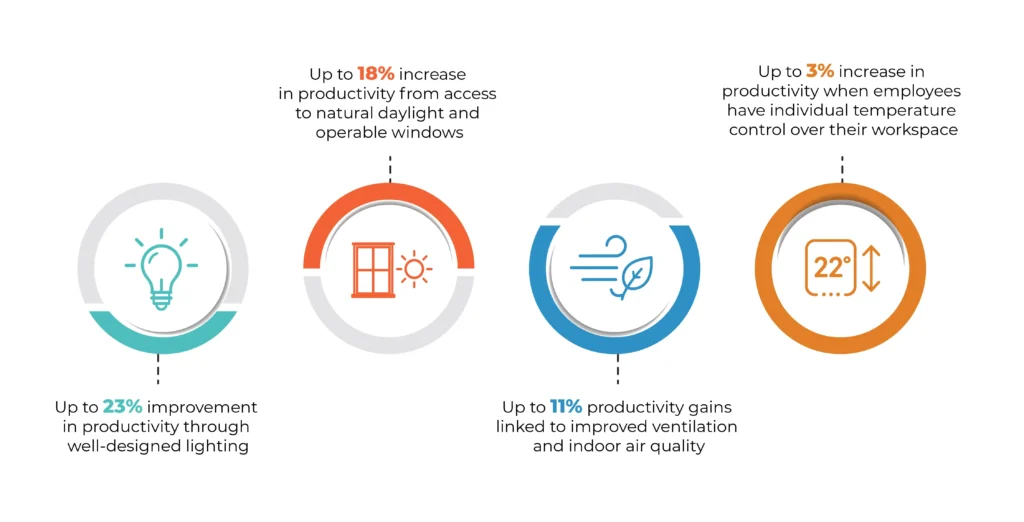
According to the World Green Building Council’s Business Case for Green Building report, sustainable buildings can significantly enhance workplace productivity and employee wellbeing. Research cited in the report found:
But designing a green building is only one part of the journey.
The true success of a green building is defined in how efficiently it is operated, maintained and sustained every single day. This is where intelligent, data-driven facility management steps in as the engine that powers sustainable infrastructure. From consistently maintaining LEED and IGBC compliance standards to enabling productive workplaces, facility management now plays a critical role in how modern buildings perform, evolve and create long-term value.
How an Integrated Facility Management Strategy Helps
Optimise Energy Efficiency
Continuous monitoring of HVAC systems, lighting, energy meters and utilities helps reduce energy intensity while maintaining occupant comfort. Smart automation and IoT-enabled energy management further improve operational visibility and performance.
Improve Indoor Environmental Quality
Healthy buildings are becoming central to employee productivity and wellness. Green FM practices ensure better air quality, thermal comfort, low-VOC materials and hygienic workplace environments aligned with sustainability standards.
Strengthen Waste and Water Management
Sustainable FM operations support waste-water treatment, rainwater harvesting, responsible waste segregation and circular resource management—key requirements in most green certification frameworks.
Support ESG and Compliance Goals
As organisations sharpen focus on ESG reporting and sustainable operations, facility management partners increasingly play a role in sustainability audits, compliance documentation, operational benchmarking and certification renewals.
What Enterprises Should Look for in a Sustainable Facility Management Partner
As green-certified buildings, GCC campuses, and ESG-led workplaces continue to scale across India, organisations will increasingly need facility management partners that can go beyond traditional maintenance models and support long-term sustainability performance.
Key capabilities enterprises should evaluate include:
- Green building certification and renewal support
- Expertise in LEED, IGBC, and green building compliance standards
- Accredited sustainability professionals such as IGBC-AP or LEED-certified experts
- Strong energy optimisation and utility management capabilities
- IoT-enabled monitoring and smart building integration
- Indoor air quality and occupant wellbeing management
- Renewable energy and REC support
- Water conservation and wastewater reuse expertise
- ESG reporting and sustainability benchmarking support
- Predictive and data-driven maintenance capabilities
- Energy auditing support through BEE-certified energy managers and auditors
- Scalability across large campuses, GCCs and multi-site operations
In the future of work, the success of sustainable buildings will be defined not just by how they are built — but by how intelligently they are operated, experienced and sustained every single day.